DIAMOND DOTTED PAPER
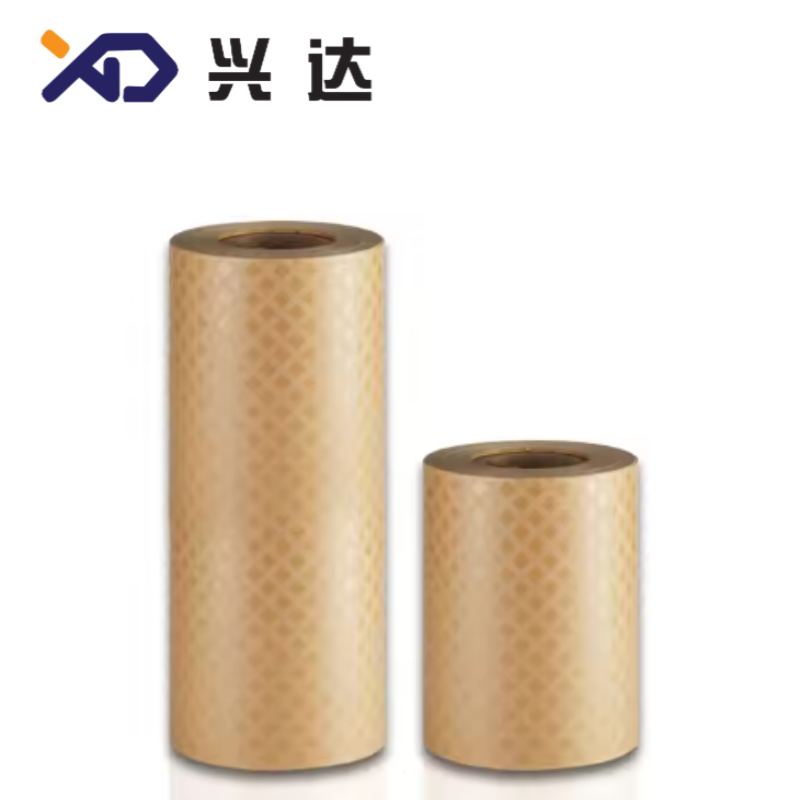
Diamond Dotted Paper for Oil Immersed Transformer Winding Insulation
Diamond Dotted Paper (DDP) – Complete Technical Guide for Transformer Insulation
Introduction of DDP
Material Structure & Working Principle
- Base Substrate: High-density cellulose kraft paper made from pure sulphate wood pulp. It offers consistent tensile strength, tear resistance and stable dielectric performance in oil-filled environments. Crepe kraft base versions are also available for applications requiring improved flexibility.
- B-Stage Epoxy Resin Dots: Thermosetting adhesive printed in repeating diamond layouts. At ambient temperature, the resin remains dry, non-sticky and stable. When heated to 90°C–130°C during coil drying procedures, the dots soften, flow and permanently cure into C-stage solid adhesive. Once cured, bonding strength remains stable under continuous operating temperature cycles.
Key Advantages of Diamond Dotted Paper
| Benefit | Technical Explanation |
|---|---|
| Improved Short-Circuit Withstand Capacity | Cured epoxy bonds lock winding layers together, preventing conductor shift and coil deformation under huge electromagnetic forces during power system short-circuit faults. |
| Suppression of Electromagnetic Vibration | Eliminates relative movement between copper conductors during continuous operation, reducing insulation abrasion and lowering transformer noise level. |
| Optimized Oil Impregnation & Drying Performance | Gaps between diamond dots allow free movement of transformer oil and moisture vapor; reduces trapped air and partial discharge risks. |
| Stable Dielectric Performance | Base kraft paper maintains consistent dielectric strength after curing; compatible with mineral oil, natural ester and synthetic dielectric fluids. |
| Controlled, Permanent Bonding | Bonding only activates during factory heating cycles; no premature sticking during storage, cutting and winding processing. |
| Flexible Product Selection | Available in single-sided coating and double-sided coating variants to match different winding structure designs. |
| Compliance with International Standards | Formulated and tested to meet IEC 60554, IEC 60641 and related transformer insulation specifications. |
Standard Technical Specifications
| Item | Typical Parameter Range |
|---|---|
| Base Material | Electrical kraft paper / electrical crepe kraft paper |
| Coating Type | Single-sided diamond dotted epoxy; Double-sided diamond dotted epoxy |
| Common Thickness | 0.08 mm, 0.13 mm, 0.18 mm, 0.20 mm, 0.25 mm, 0.30 mm, 0.38 mm, 0.50 mm |
| Standard Width | 500 mm – 1300 mm; custom slit widths available |
| Thermal Class | Class A (105°C) standard; thermally upgraded grades optional |
| Activation Temperature | Starting melting: ~90°C; complete curing: 120°C – 130°C |
| Bonding Strength (After Curing) | ≥ 450 kPa under standardized test conditions |
| Moisture Content | 4.0 % – 8.0 % |
| Storage Condition | Dry, ventilated warehouse, below 30°C, away from direct sunlight and heat sources |
| Supply Form | Master rolls, slit narrow rolls, custom cut sheets |
Main Application Scenarios
- Interlayer insulation and bonding for LV and HV windings of distribution transformers (10kV, 20kV, 33kV class)
- Winding interlayer insulation for medium voltage power transformers
- Coil insulation for shunt reactors and series reactors
- Winding insulation of current transformers (CT) and voltage transformers (VT)
- Inter-turn and inter-layer insulation for furnace transformers and special industrial transformers
- Retrofit and rewinding projects for existing oil-type transformers
Single-sided DDP is widely used for basic interlayer bonding where only one surface needs adhesion. Double-sided diamond dotted paper is selected for heavy-duty transformers, high-fault-current applications and reactor coils requiring rigid winding block structure on both sides of insulation layers.
Diamond Dotted Paper vs. Ordinary Kraft Insulation Paper
| Comparison Item | Diamond Dotted Paper (DDP) | Standard Plain Kraft Paper |
|---|---|---|
| Bonding Function | Self-bonding after thermal curing | No adhesive property |
| Winding Stability | Forms rigid winding block; anti-vibration & anti-displacement | Layers remain loose; prone to shift under short-circuit stress |
| Vacuum Drying & Oil Impregnation | Excellent, thanks to spaced dot pattern | Good, but no bonding capability |
| Partial Discharge Risk | Lower; fewer internal air gaps after curing | Higher risk of micro-movement and air gap formation over time |
| Typical Usage | Distribution transformers, reactors requiring fixed windings | General insulation barriers, cylinder liners, non-bonded spacing layers |
Processing & Curing Guidelines
- Wind coils with diamond dotted paper placed between winding layers; maintain uniform pressure during winding.
- Conduct vacuum drying with staged temperature rise. Hold temperature between 90°C and 130°C for sufficient duration to ensure epoxy dots fully melt and cross-link.
- Avoid rapid temperature spikes that cause uneven resin flow.
- After curing, allow coils to cool gradually before oil filling.
Improper curing temperature or insufficient holding time will lead to incomplete resin cross-linking, resulting in insufficient bonding strength and reduced long-term reliability.
Storage Recommendations
- Store diamond dotted paper in clean, dry indoor environments with relative humidity below 65%.
- Keep products away from radiators, boilers and direct solar radiation. High temperature during storage may cause premature resin aging.
- Keep rolls sealed inside original packaging until use to prevent moisture absorption.
Rotate stock following first-in first-out practice to maintain consistent adhesive activity.
Frequently Asked Questions
Q1: Can diamond dotted paper be used in dry-type transformers?
Q2: What is the difference between diamond dotted paper and diamond dotted crepe paper?
Q3: Does cured epoxy resin contaminate transformer mineral oil?
Q4: Can I customize thickness and roll width?
Categories
Contact Us
Contact: Tianjin Delda Trading Co., Ltd
WhatsApp: +86 13662056855
Tel:
E-mail: solomon20210701@tjxddq.com
Add: Unit‑101, Workshop 3, Bozhong Automobile Industrial Park, No.5 Xianghui Road, Intersection of Xianghui Road and Gaoying Road, Beizhakou Town, Jinnan District, Tianjin, China