Tap changer
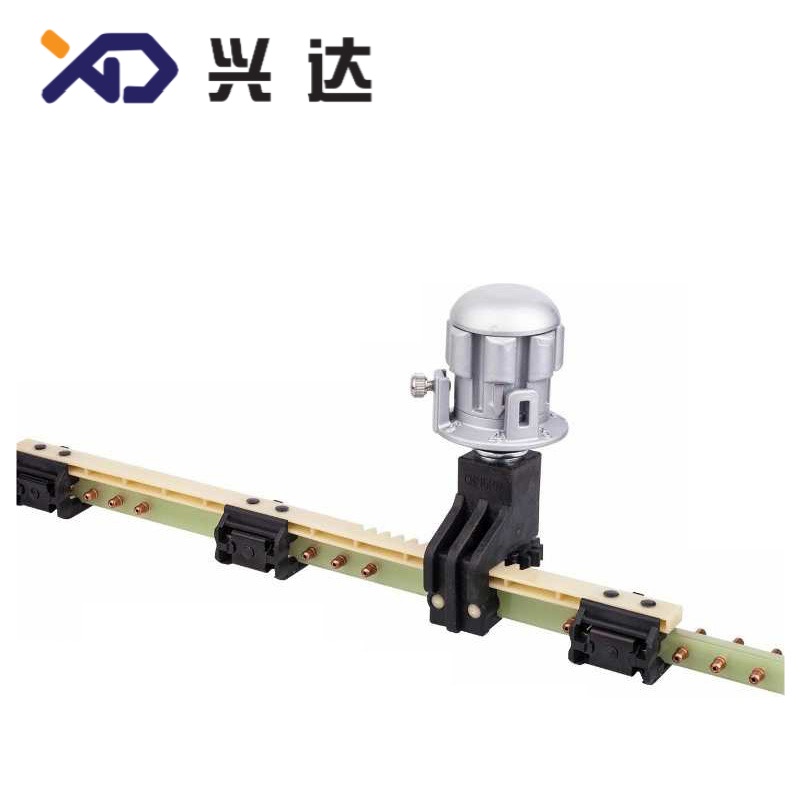
Disconnectors Introduction
Disconnectors
Definition:
A disconnector is a switching device primarily used for ‘isolating power sources, switching operations, and connecting and disconnecting circuits carrying low currents’, and does not possess arc-extinguishing capabilities. When in the open position, a disconnector has an insulation distance between the contacts that meets specified requirements and a clear indication of disconnection; when in the closed position, it is capable of carrying the current under normal circuit conditions as well as the current under abnormal conditions (such as a short circuit) for a specified period of time. Generally used as high-voltage isolating switches—that is, those with a rated voltage of 1 kV or above—their operating principle and structure are relatively simple. However, due to their widespread use and the high reliability requirements placed upon them, they have a significant impact on the design, construction and safe operation of substations and power stations. The main characteristic of isolating switches is their lack of arc-extinguishing capability; they can only open or close circuits in the absence of load current.
Types:
Based on their installation method,
they can be classified as outdoor isolating switches and indoor high-voltage isolating switches. Outdoor isolating switches are those capable of withstanding the effects of wind, rain, snow, contamination, condensation, ice and heavy frost, and are suitable for installation on open platforms.
Based on the structure of their insulating supports,
they can be classified as single-column isolating switches, double-column isolating switches and triple-column isolating switches. Among these, single-column isolating switches utilise the vertical space directly beneath overhead busbars as the electrical insulation for the breaking gap. Consequently, they offer the distinct advantages of saving floor space, reducing the length of connecting cables, and providing a particularly clear indication of the open and closed positions. In ultra-high-voltage transmission applications, the space-saving benefits are even more pronounced when single-column isolating switches are adopted in substations.
Classified by voltage rating
Low-voltage isolating switches High-voltage isolating switches
Common high-voltage isolating switch models
CR Centre-break isolating switch (126 kV–252 kV)
DR Double-sided isolating switch (72.5 kV–363 kV)
KR Double-column horizontal telescopic isolating switch (126 kV–550 kV)
PR Single-column, double-arm vertical telescopic isolating switch (126 kV to 500 kV)
SR Horizontal rotary single-sided break isolating switch (40.5 kV)
VR V-type centre-break isolating switch (126 kV)
YR Single-column, single-arm vertical telescopic isolating switch (126 kV–550 kV)
Other:
(1) There are single-phase and three-phase isolating switches.
(2) Three-phase isolating switches are available in ceramic and silicone rubber versions; the silicone rubber versions are more expensive than the ceramic ones.
(3) Testing of isolating switches generally includes breaking capacity, power frequency, lightning impulse, loop resistance and manual operating torque.
(4) If customers require a test report, they may enquire about the test methods to determine which type of report is required.
Categories
Contact Us
Contact: Tianjin Delda Trading Co., Ltd
WhatsApp: +86 13662056855
Tel:
E-mail: solomon20210701@tjxddq.com
Add: Unit‑101, Workshop 3, Bozhong Automobile Industrial Park, No.5 Xianghui Road, Intersection of Xianghui Road and Gaoying Road, Beizhakou Town, Jinnan District, Tianjin, China